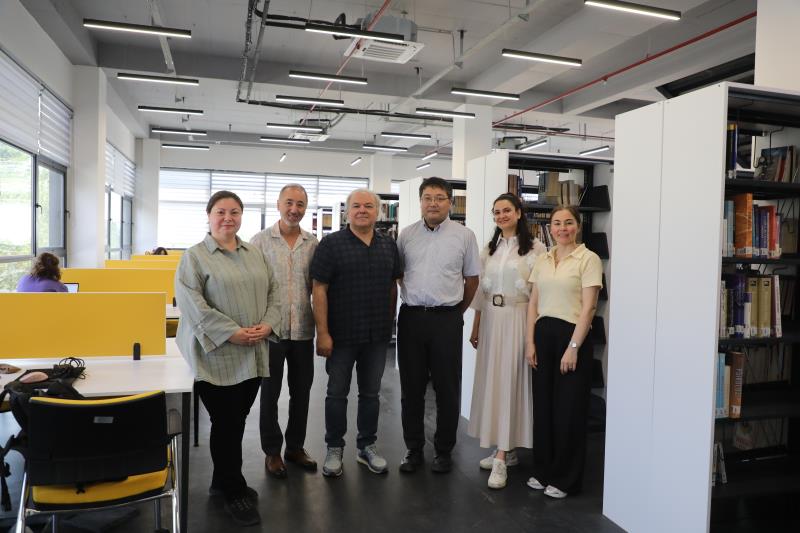
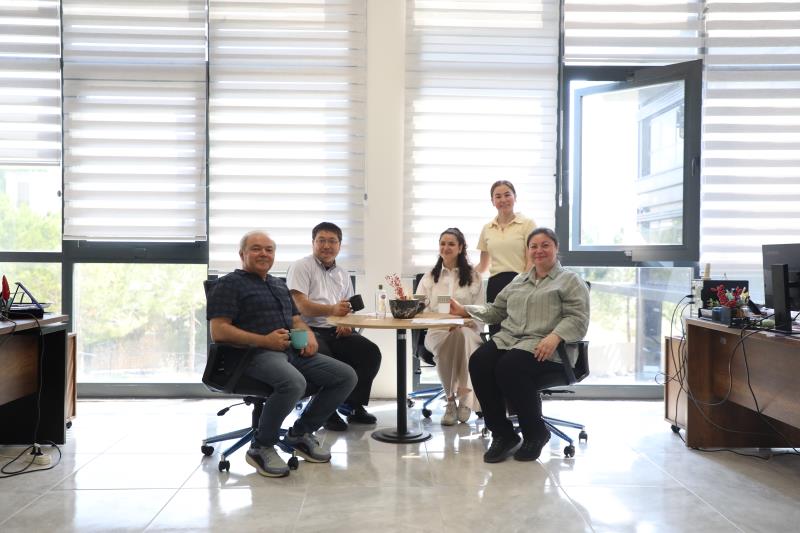
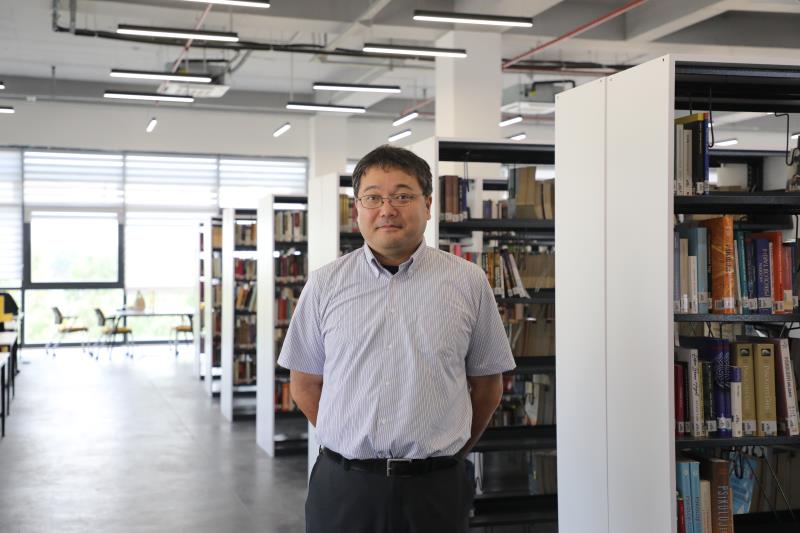
Within the scope of the Erasmus+ KA171 program, we were deeply honored to host the esteemed academic Assoc. Prof. Dr. Hidetoshi Miyazaki from Nagoya Institute of Technology, one of Japan's well-established institutions, on our campus.
We take great pride in our university being a vibrant hub for Erasmus+ programs, bringing together dedicated minds from all around the world. We would like to express our heartfelt gratitude to Dr. Miyazaki, who honored us with his visit, for sharing his valuable insights, his academic expertise, and his sincere impressions of our university.
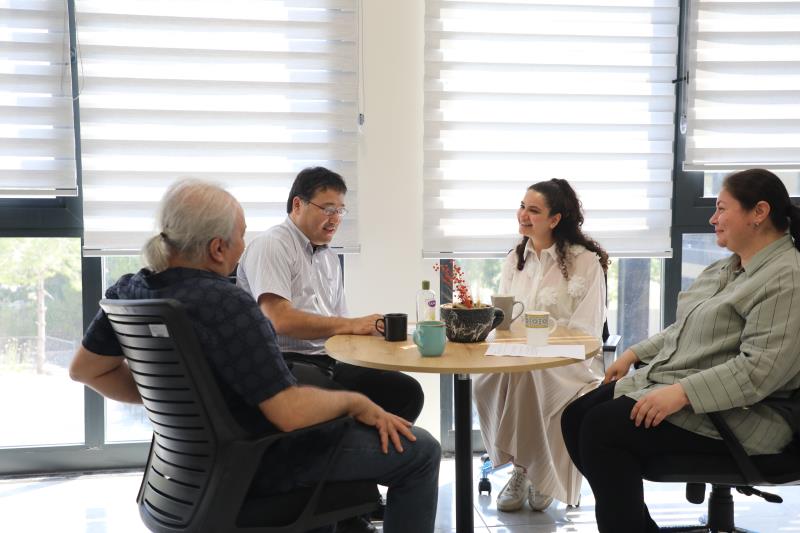
Below, we are pleased to share the candid responses given by our esteemed guest in the interview we conducted regarding our campus life, bilateral collaborations, and cultural bonds:
🎙️ An Interview with Assoc. Prof. Dr. Hidetoshi Miyazaki
- First of all, welcome to our university! Is this your first time visiting Türkiye and our university? What are your very first impressions?
“This is my second visit to Türkiye. During my previous visit, I traveled by bus from Istanbul to Afyon and then to Tarsus. This time, I came to Tarsus by plane from Istanbul. Through these experiences, I once again felt that Türkiye is a very large and dynamic country.
The scenery I saw from the airplane changed dramatically from place to place, and it was truly beautiful. I was strongly impressed by the richness of Türkiye’s nature and landscape. I also felt that the people in Türkiye are very kind and friendly. When they realized that I was from Japan, many people kindly spoke to me, and I really enjoyed having conversations with them. My first impression is that Türkiye is a country full of warmth, energy, and hospitality.”
- Compared to Japan, what surprised or interested you the most about our campus life or the city?
“What impressed me the most was seeing students and people in the city talking outside with a glass of çay in their hands. In Japan, many people tend to look at their smartphones, and communication is often done through social media. Therefore, I felt that Turkish culture places great importance on direct communication and human relationships.
After greeting someone, they would naturally ask, “Would you like çay or coffee?” I really appreciated this kind of atmosphere, where people can easily start a conversation and spend time together. It was very warm and comfortable for me.
However, I think I drank about ten glasses of çay every day, so I was always full! But this was also one of the most enjoyable and memorable parts of my stay in Türkiye.”
- The Erasmus+ program builds bridges with countries outside Europe. What are your thoughts on being a part of this program and the collaboration between our institutions?
“I think the Erasmus+ program is a very valuable and meaningful program. International collaboration and inter-university partnerships do not always begin with large formal research projects. Very often, they begin with human exchange. When researchers, staff, and students actually visit each other’s universities, they can understand the real atmosphere of the university, the city, and the people. This kind of direct experience makes collaboration more natural and stronger.
Tarsus University is a young university, and I felt that it has a very energetic atmosphere. I was also impressed by the active attitude of the students and the positive atmosphere throughout the university. I believe that exchanges between Tarsus University and Nagoya Institute of Technology will be very stimulating for young people in both countries.
I also hope that we can combine the knowledge, technologies, and experiences of both universities to contribute to solving various issues in Türkiye, Japan, and the wider international community. For me, Erasmus+ is not only a mobility program, but also a starting point for building long-term trust, friendship, and future research collaboration.”
- How do you see this mobility contributing to future projects or student/staff exchanges between our universities?
“I believe this mobility will become an important first step toward deeper collaboration between our universities. Through this visit, we were able to meet face to face, exchange ideas about research and education, and understand each other’s research environments and university atmosphere. These experiences are very important for developing collaborations based on mutual trust.
In addition, when countries and regions are different, there are also differences in cultural backgrounds, lifestyles, and religious values. However, I believe that directly experiencing such differences and learning to respect each other is extremely valuable for students. In the future, the perspective of international multicultural coexistence will become increasingly important. Exchanges among people with diverse cultural backgrounds can lead to the sharing of different ways of thinking and values, which may also become a source of new research ideas and collaborative research themes.
In the future, I hope this exchange will lead to joint research projects, student exchanges, staff exchanges, and possibly joint supervision of students. For example, students from both universities could visit each other’s laboratories, learn different research methods, and experience different academic cultures. Such experiences would be very valuable for students.
I would also like to develop practical collaborations by combining our expertise in materials science, energy-related materials, and advanced characterization techniques. I hope that this Erasmus+ mobility will become a foundation for continuous and fruitful cooperation between Tarsus University and Nagoya Institute of Technology.”
- What advice would you give to Japanese scholars and students who are considering participating in an Erasmus+ mobility program to Türkiye in the future?
“I would strongly recommend Japanese scholars and students to participate in an Erasmus+ mobility program to Türkiye. Although Türkiye and Japan are geographically far from each other, I felt that the psychological distance between the two countries is very close. Many Turkish people have a very positive image of Japan, and Japanese people also have a friendly impression of Türkiye. Therefore, I think it is easy to build good relationships.
Of course, there are differences in culture, lifestyle, and religious background between Japan and Türkiye. However, actually experiencing these differences and respecting the culture and values of others is a very important learning experience for students. In the future, the ability to cooperate with people from diverse cultural backgrounds will become increasingly important in international research and work environments.
Türkiye is a safe and welcoming country, and the food is also very delicious. More importantly, people are kind, open, and very willing to communicate. For Japanese students, visiting Türkiye would be a wonderful opportunity to learn not only about research and education, but also about culture, human connections, and the importance of international exchange.
My advice is very simple: please do not hesitate to participate. Talk with many people, drink çay together, enjoy the food, and experience the local atmosphere directly. I believe that such experiences will become a very important asset not only for their growth as researchers, but also for their personal development as individuals.”